
If you want to build a workout habit that finally holds, the answer isn’t more willpower. It’s a better setup. Most people don’t quit the gym because they’re lazy. They quit because they tried to change everything at once, ran out of steam by week two, missed a few days, and decided the whole thing wasn’t working. If that sounds familiar, you’re in good company, and you’re closer than you think.
I’ve coached people around Angelina County for years, and the folks who stick around aren’t the most motivated ones. They’re the ones who made working out small, convenient, and hard to skip. That’s the whole trick. The goal here is to build a workout habit that sticks because the system holds it up, not because you white-knuckle your way through every day. Here’s how to do it, the honest way, without the cheerleading.
Build Your Workout Habit on Systems, Not Willpower
Here’s the mistake nearly everyone makes. You decide you’re going to work out an hour a day, five days a week, starting Monday. You go hard for a week or two. Then life happens. A kid gets sick, a shift runs long, and the whole plan feels impossible to restart.
The fix is to start small, so small you can’t talk yourself out of it. Ten minutes. One walk on the treadmill. Two sets on a couple of machines. That’s it. I know it feels like it’s not enough to matter, but you’re not training for a competition right now. You’re training the habit itself. When you start small, you reduce friction, and reducing friction is the real secret to exercise consistency. This is how you build a workout habit that lasts: you make the first step too easy to refuse.
When the bar is low, you show up on the bad days too. Showing up on the bad days is what separates people who build a workout habit from people who keep starting over. Once coming to the gym feels normal, adding more time and harder work is easy. Building the routine from nothing is the hard part, so don’t make it harder than it has to be. A small workout you actually do beats a perfect workout you skip. Every single time.
What Is Habit Stacking, and How Do I Use It?
If you want to build a workout habit without relying on memory or mood, habit stacking is one of the best tools you’ve got. Habit stacking is a plain idea with a fancy name: tie a new habit to one you already have locked in. You already brush your teeth, drink your coffee, clock out of work, drop the kids at school. Those are anchors. You don’t have to remember to do them, they just happen. So you attach the gym to one of them.
It might look like this:
- After I drop the kids at school, I drive straight to the gym before I go home.
- When my shift ends at the mill, I stop at Diboll Fitness on the way back.
- After my morning coffee, I change into my gym clothes before I do anything else.
This works because you’re not relying on remembering or feeling like it. The first habit pulls the second one along behind it. You’ve already got dozens of these anchors running on autopilot. Pick one near a time you could realistically train, and bolt your workout onto it. Stacking is one of the simplest ways to build a workout habit, because the anchor does the remembering for you. One more tip: lay your gym bag by the door or keep it in the truck. Make the next step obvious. The less thinking required, the better.
How Do I Stay Consistent? Reduce the Friction
Be honest with yourself about the number one reason people skip workouts. It’s not soreness or boredom. It’s that the gym is closed when they’re free, or it’s a hassle to get to, or it’s packed and uncomfortable. Convenience isn’t a luxury when you’re trying to build a workout habit. It’s the whole ballgame. You can’t build a workout habit around a gym you can’t get into.
A 24/7 gym changes things for real people with real schedules. If you work nights at the plant, you can train at six in the morning when you get off. If you’re a parent and the only quiet window is nine at night after the house settles down, the door’s open. Diboll Fitness uses secure, app-based entry, so you come and go on your time, not somebody else’s posted hours. Proximity matters too. A gym fifteen minutes out of your way gets skipped on tired days. One that’s close to home or on your route doesn’t.
It helps that we’re a smaller, no-crowd facility too. A lot of folks getting back into fitness feel self-conscious walking into a packed room full of strangers. Here you’re not fighting for a machine or waiting on a bench. That lowers the friction, and lower friction means you actually go. The CDC has a solid rundown on overcoming common barriers to being active, and almost every one of them comes back to making the thing easier to do. If you’ve been on the fence, our free 2-day trial is a low-pressure way to see whether the place fits your routine before you commit to anything.
How Do I Work Out With No Motivation?
Let’s talk about motivation vs discipline, because a lot of people get stuck right here. Motivation is that burst of energy you feel on January 1st, or after you see an old photo, or when a doctor gives you a number you didn’t like. It’s real, and it’s useful for getting started. But it’s also weather. It comes and goes, and you can’t build anything permanent on something that unreliable.
Discipline is different. Discipline is what gets you to the gym on the gray Tuesday when you’re tired and nothing about it sounds fun. And here’s the part nobody tells you: discipline isn’t a personality trait. It’s a system. When you’ve stacked your workout onto a daily anchor, kept it small enough to manage, and made it convenient to get to, you don’t need much willpower at all. The system carries you on the days motivation doesn’t show up. That’s exactly why you build a workout habit on structure instead of feelings.
So when you’ve got no motivation, you don’t try harder. You shrink the task. Tell yourself you’ll just go put your shoes on and drive over for ten minutes. Nine times out of ten, once you’re there, you do more. The other one time, ten minutes still counts and the streak survives. That’s how you keep an exercise routine alive through a flat week.
It also helps to remember why any of this matters. Regular movement does real things for your body and your head. Harvard Health explains why a mix of exercise types pays off, and Mayo Clinic lays out the benefits of regular physical activity, from better sleep and mood to lower risk of a long list of health problems. You don’t have to do a lot, either, especially at first. Keeping that bar low is exactly how you build a workout habit that survives a busy season.
How Do I Get Back on Track After Missing Workouts?
You will miss workouts. I promise you. Somebody’s going to get the flu, your truck will need work, a holiday will throw off the week. This isn’t failure. It’s just life in a small town with a full schedule. The people who quit are the ones who treat a missed day like proof they can’t do it. The people who build a workout habit that lasts have a rule ready.
The rule I give folks is simple: never miss twice in a row. Miss one day, fine, it happens. But make the next session non-negotiable, even if it’s a short one. One missed workout is a blip. Two in a row is how a habit quietly dies. And when you come back after a gap, don’t try to “make up” for it with some brutal punishment session. That just makes the gym feel like a chore you owe a debt to. Pick right back up where you left off, keep it reasonable, and move on.
If you’ve already fallen off for a few weeks or a few months, the same rule applies, just gentler. Don’t start back at where you stopped. Start back at the small version, the ten-minute version, and let the habit rebuild. Building a workout habit that sticks is a long game, measured in months and years, not in any single perfect week. Falling off and getting back on is part of the process, not a sign you’ve failed it.
Lean On Accountability and Familiar Faces
Here’s something a big-box gym in the city can’t really offer: people who know your name. In a smaller, locally owned place, the staff notice when you’ve been in and notice when you haven’t. Other members start to recognize you. That quiet accountability is a real force. When you know somebody might say “haven’t seen you in a bit,” you’re a little more likely to show up. An accountability partner is one of the most reliable ways to build a workout habit when you’re starting out.
You can make this work harder for you on purpose. Grab an accountability partner, a spouse, a coworker, a neighbor, and agree to text each other after each session. You don’t have to train together. You just have to answer to somebody. A standing “did you go today?” text does more for consistency than any fancy app. If you want to know more about the place and the people behind it, take a look at who we are and why we built this gym for the community in Diboll, Lufkin, and the rest of Angelina County.
Track It Simply to Build a Workout Habit That Lasts
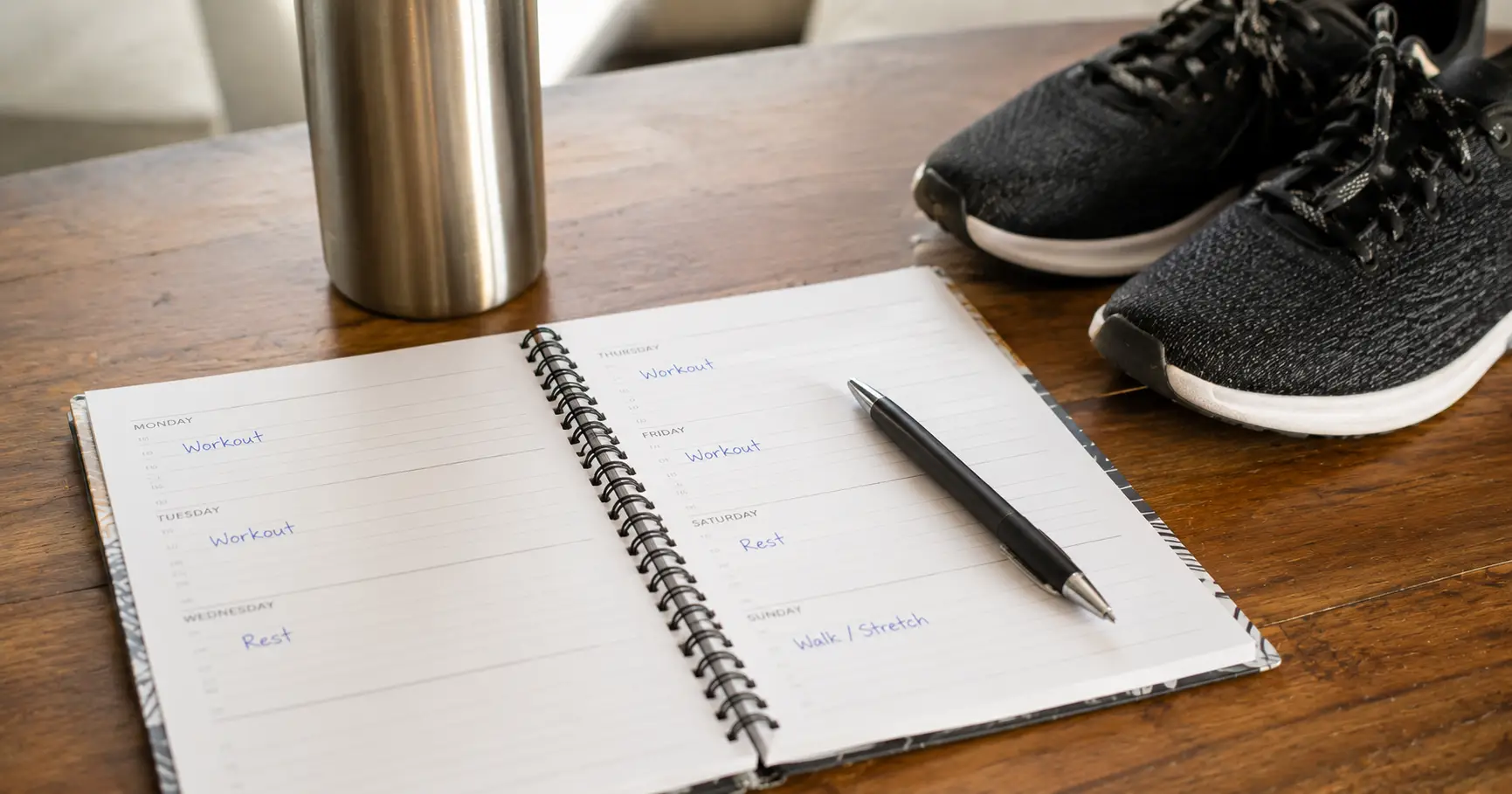
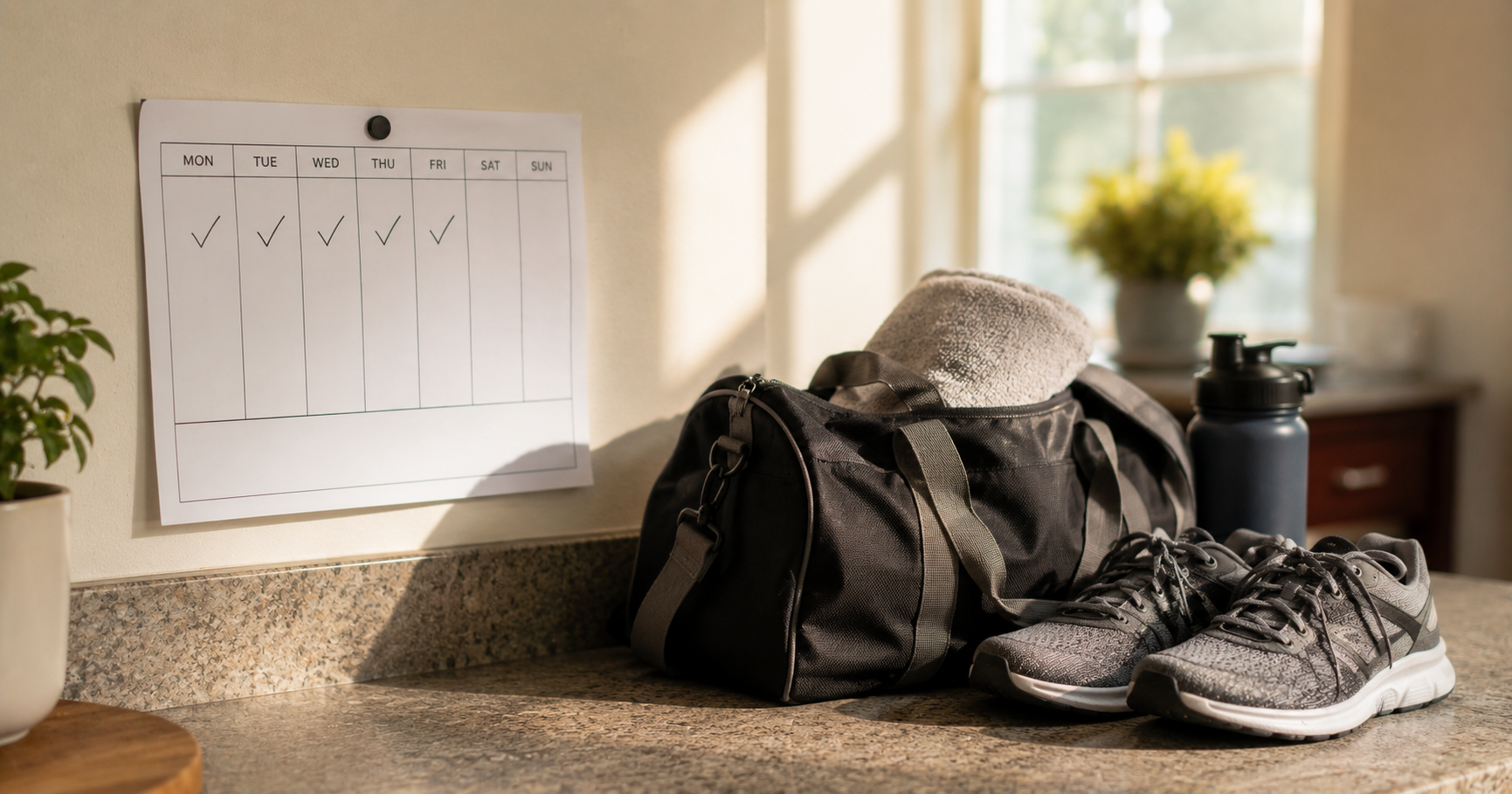
You don’t need an app with charts and graphs and a heart-rate algorithm to build a workout habit. You need a way to see that you’re showing up. That’s it. The simplest thing in the world works best: mark an X on a calendar every day you train. After a couple of weeks, you’ve got a little chain of X’s, and you won’t want to break it. That visual streak is surprisingly powerful. It turns the abstract goal of “get in shape” into a concrete game of “don’t skip today.”
If you want a little more, jot down two things per session: what you did and how it felt. A note as short as “20 min treadmill, legs felt strong” tells you plenty over time. You’ll start to see patterns in which days you train best. Keep it light, though. The tracking is there to serve the habit, not to become another job.
Putting It All Together
None of these pieces is complicated on its own. To build a workout habit that holds, start absurdly small. Anchor it to something you already do. Make it convenient enough that skipping is harder than going. Have a rule for missed days. Use a little accountability. Track it simply. And lean on your system instead of your mood. Stack those together and you’ve got a routine that survives the rough weeks.
If you’re not sure how many days a week you ought to be aiming for as you build, we wrote a whole piece on how often you should work out that pairs well with this one. Start with the habit first, then dial in the frequency. When you’re ready to make it official, our membership plans are straightforward, and you can always reach out with any questions before you decide.
This is the part of fitness that doesn’t get enough attention. Everybody wants to argue about the perfect program or the best exercise. Almost nobody talks about the boring, reliable work of becoming the kind of person who shows up. That’s where the results come from. Not from one heroic month, but from a hundred ordinary days strung together. You can do this. Folks all over Diboll, Lufkin, and the rest of Angelina County are doing it right now, one small session at a time.
Frequently Asked Questions
How long does it take to build a workout habit?
Most research suggests it takes somewhere between two and three months to build a workout habit, with an average around 66 days, not the often-repeated 21. The exact number varies by person, so don't watch the calendar too closely. Keep your sessions small and regular, and the routine will start to feel automatic on its own timeline.
Why do I keep quitting the gym?
Usually it's not a willpower problem. It's that the plan was too big, the gym was inconvenient, or one missed week turned into a quit. Fix the setup instead of blaming yourself. Start small, reduce friction, and follow the never-miss-twice rule, and you'll build a workout habit that finally outlasts the quitting pattern.
What's the best time of day to work out for consistency?
The best time is whenever you'll actually do it consistently. Morning, lunch break, or late at night all work fine. With 24/7 access at Diboll Fitness, you can pick the window that fits your shift and your family, then anchor your workout to something you already do at that time so it sticks.
How many days a week should a beginner start with?
Two or three days a week is plenty when you're starting out, and it's far more sustainable than trying to go every day and burning out. You can always add days once the habit is solid. For a fuller breakdown, see our guide on how often you should work out.
Do I need to feel motivated to get results?
No. Motivation is helpful for getting started but too unreliable to build on. The people who stick with it lean on a system instead: small workouts, a daily anchor, and a convenient gym. When the setup makes showing up easy, you don't need to feel inspired to follow through.